
From Lyrics to Legacy: The Skills Inside the Songs
There is a difference between knowing something and having it in your body.
You can sit through hours of a course on how the mind works, take good notes, nod in all the right places, and walk out with every bit of it still on the page. Then one evening a song comes on, a few minutes long, and something in you actually moves. Your shoulders drop. You breathe differently. You remember who you are. That is not a small thing, and it is not an accident. The right song can take you somewhere a lecture never will, and help you connect with yourself on the way.
Behind the album and every single is the founder of Awakened Beats and the Awakened app, a licensed clinician and mindfulness coach. Whatever he teaches in his sessions and workshops, some of it finds its way into the songs: the concepts, the skills, the examples. A lecture gives you an idea once. A song gives it to you every time you press play, and before long in your own voice.
So far there is one album and three singles, and every one of them has a skill inside it. Here is what each one does.
Four Songs, Four Skills
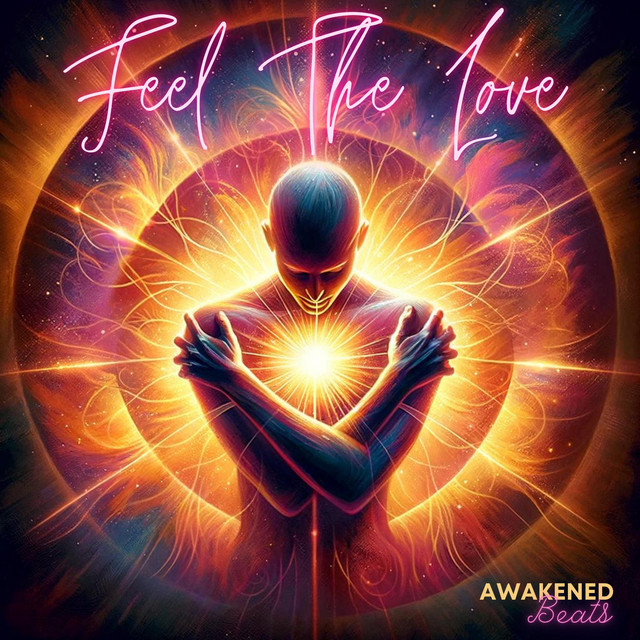
Feel the Love: the song that asks you to hug yourself
Listen to the order of it.
The first verse asks you to remember a time you were held. Then the chorus, the part you end up humming without meaning to, gives an instruction you would never expect in a song: hug yourself. The second verse turns the memory around and asks for a time your own heart reached out to someone else. And the bridge stops being a song at all and simply tells you to put your hands on your heart and breathe.
That is the shape of a self-compassion exercise, step by step. Recall receiving love. Hold yourself. Recall giving love. Hand on your chest, breathe. The outro even tells you when to come back to it: when you are feeling low.
The idea underneath comes up constantly in sessions. There are many kinds of love, and every one of them draws on the same deep well inside you. When you are easy on yourself, you tend to be easier on the people around you too. The song does not explain any of that. It walks you through it, a few minutes at a time, until one day you catch yourself doing it with no song playing at all.
Rise & Stand Tall: three colors to reach for on a bad day

The chorus is a short list. Brave. Loved. Wise. Three things a person already has and forgets about the moment they are low or overwhelmed.
What is easy to miss is that the song gives each one a color. Gold for the brave part. Red for love. Blue for wisdom. You can put that to work. Pair one quality with one color and one song, and on a bad day you have a shortcut back to yourself. You think of the color, and you have somewhere to start.
The point the song keeps making is that these are not things to go and get. You have already done something brave in your life. You have already made a wise decision, probably more than one. You have loved and been loved, and if you are open and genuine when you need people, they tend to show up, whatever the internet makes it look like. None of that goes away because you have not used it in a while. You are the hero in your own story. The song is a reminder of a role you already have.
Monkey Got The Wheel: catch yourself

Every version of this song opens with the same question. Monkey, monkey, got the wheel?
The monkey is the restless, chattering part of the mind that grabs control when you are not looking. Old habits. The story you tell about your past. The thought you have had ten thousand times. The song’s whole argument is that your thoughts, your habits and your past should not be the ones driving your car. You are more than those things, and when they are driving, you do not enjoy the ride.
The answer is two words long. Catch yourself. Not fight yourself, not fix yourself. Just notice who has the wheel, and take it back. You are the author of your own story, and the ride is yours to steer.
The album is seven tracks, each one revisiting a familiar lyrical tale with a fresh musical twist: smooth hip hop, hip hop, Jamaican rap, reggae, country, pop and psychedelic swing. Whichever one works for you, pick it, put it on, and sing along. If country is what reaches you on a long drive, that is the version to keep on a loop.
One listener told us about a hard exchange at home. Instead of doing what he would usually do, which was argue or punch a wall, he got in the car, went for a long drive, and played it. He could tell his thoughts and feelings had taken over. He needed some room to come back to himself, and the drive and the song gave him that room.
No Mud No Lotus: let the clouds pass

This one asks you to treat your thoughts and feelings as guests. They arrive uninvited, and you are asked not to run and not to hide, but to acknowledge them, accept them, and give them space.
Then it hands you the picture that does the work. You are the sky, and your thoughts and emotions are clouds. You are the ocean, and they are waves. A cloud is real, and it can be dark, and it is not the sky. You do not have to fight it, chase it away, or become it. Fighting a feeling usually makes it louder. Running from it usually makes it follow. Becoming it is how a bad hour turns into a bad decision. The alternative is to stay where you are and let it move through, which is what clouds do. The sky is still there afterwards. And if a feeling is not passing, or is frightening, that is the moment to reach for a person rather than a song.
Then there is the title. The lotus grows out of mud, and there is no lotus without it. The hard stuff is not the opposite of growth. It is the ground growth comes up through. Welcome the rain, the song says. Welcome the storm.
What a song is, and what it is not
A song can be real company. It can carry an idea into an hour where nothing else would fit, and it can put it in your own voice, which is where it finally takes. It cannot do what a person trained to help you can do.
One gentle note. These songs, and the Awakened app, are wellness companions, not a substitute for professional care. If things feel heavy, or you are in crisis, please reach out for human help rather than waiting. In the US you can call or text 988, the Suicide and Crisis Lifeline, at any hour. Elsewhere, a qualified professional, your local crisis line, or emergency services can help. Music is better alongside the right human support, not instead of it.
The word legacy in the title is not about the songs. A song is a few minutes long and then it is over. What it leaves behind, if it works, is the skill: the hand on the chest, the color you reach for, the two words you say to yourself in the car. Those stay after the music stops. That is the part meant to last.
So pick the version that reaches you. Put a hand on your chest when the song tells you to. Choose a color. Catch yourself.
Frequently Asked Questions
Is this music therapy?
No. Music therapy is a clinical practice delivered by a trained and credentialed music therapist, and this is not that. The founder of Awakened Beats and the Awakened app is a practicing clinician and mindfulness coach, and some of what he teaches is what the songs are built on. They are meant to sit alongside real support rather than stand in for it, and nothing here is treatment or advice. If you are looking for care, a qualified professional is the right place to start.
Which version of Monkey Got The Wheel should I start with?
Whichever one you would actually play twice. If you are a reggae person, start there. If country is what you reach for on a drive, use that one. The only wrong choice is the version you will not listen to.
Where can I listen?
The music is on Spotify, Apple Music, Amazon Music and YouTube. The videos are on the YouTube channel. The Spotify playlist and the channel are both linked in the site footer.
How does this connect to the Awakened app?
Two different things with the same intention. The app is a set of practical tools, grounded in real research, that help you come back to yourself. Its Calming Music library has our own music, including the singles and the album, alongside music for sleep, relaxation, meditation, EMDR, focus, awakening, nature sounds, and more. The Awakened Beats songs are a separate catalog, meant for a long drive or a loop on a bad day. If you want sound for sleep or focus, the calming music guide and why music calms us are the better places to go.